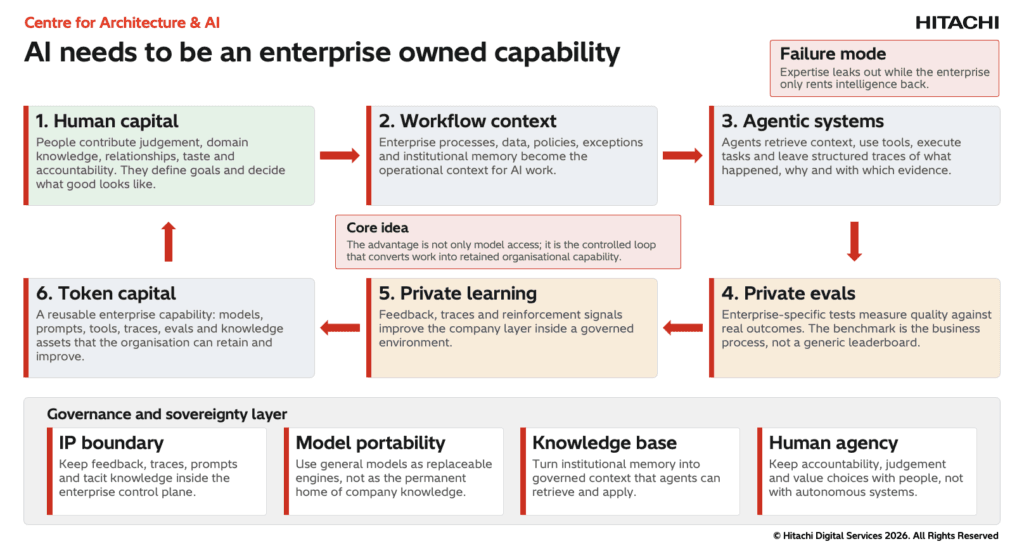
So, here is the question nobody is asking in the boardroom. Everyone is talking about AI budgets. Model costs. API spend. Pilot ROI. But the real question is simpler: after all that money, what do you actually own?
It had a warning in the corner that I cannot stop thinking about: “Expertise leaks out while the enterprise only rents intelligence back.” That is not a technology problem. It is a capital structure problem. And most companies are living it.
Here is the pattern. You bring in a team. They build an agent. They learn your domain, your exceptions, your taste. They know which clauses the legal team actually cares about and which reports the CFO actually reads. They write prompts that work. They tune the model until the output feels right. Then the project ends. The contract finishes. The team leaves. The API keeps running. But the knowledge of how and why it works? Gone. The next project starts from scratch.
You have not built an asset. You have rented intelligence by the hour.
This is the part that should worry a CxO. Your AI budget is probably growing. But what is sitting on your balance sheet? Nothing. No evals. No traces. No governed knowledge base. No reusable prompts that your own people understand. Just a recurring bill and a few dashboards that look nice until the model changes and nobody knows how to fix it.
The real story is about organisational learning. The question is whether your company gets smarter as it uses AI, or just gets faster at tasks while the underlying capability stays flat. Most companies are in the second camp. They ship agents. They automate workflows. They celebrate speed. But the expertise that made those agents work is not retained. It is not governed. It is not owned.
The alternative is a closed loop. Work happens, but it leaves traces. Feedback improves the company layer, not just the model. Evaluations are enterprise-specific, not leaderboard scores. The benchmark is whether your business process actually works better. Knowledge assets are retained and improved. The organisation owns the capability, not just the API key.
Underneath all of this is a governance question. IP boundaries keep tacit knowledge inside the enterprise control plane. Model portability means you treat general models as replaceable engines, not as the permanent home of company knowledge. A knowledge base turns institutional memory into governed context. Human agency keeps accountability with people, not with autonomous systems.
The core insight is direct. The advantage is not model access. Anyone can buy that. The advantage is the loop that converts work into retained organisational capability. But, jokes aside, this reframes the entire investment conversation. The budget line for models is not the main event. The main event is whether your company is building something it keeps, or just renting something it loses.
So here is what I would ask if I were in that boardroom. Not “How much are we spending on AI?” Not “Which models are we using?” But: “If the team that built our most important agent left tomorrow, what would we still own? If the answer is not much, you are not building AI capability. You are renting it. And the rent is going up.