2025 in Review for #RBM
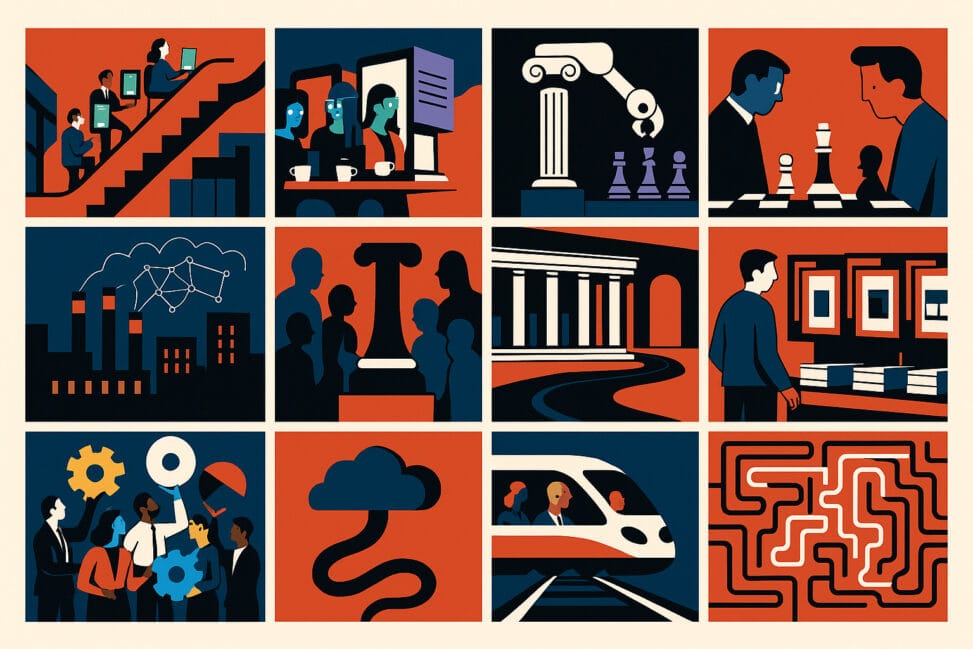
Welcome to the end of the year review for Read Before Monday! This is the last edition before the two weeks that I won’t be posting. So, here’s our year in recap 🙂 If there’s one thing this year reinforced, it’s this: technology doesn’t fix systems. It exposes them. The ones that held up in 2025 weren’t the most advanced, they were the ones that remembered their constraints. Despite the pressure points, the year closed with something quietly reassuring: systems still respond to care, not hype, where constraints were understood, progress held and where people chose stewardship over speed, the future remained workable. See you in 2026 with year predictions!
___
January: we keep relearning the same lessons
We started the year by looking backwards, and honestly, that felt right. Not nostalgia for nostalgia’s sake, but because so many of today’s “new” problems are just old ones with better branding. Early internet history, forgotten educational machines like the Unisys ICON, and the Pentium FDIV bug all resurfaced as reminders that complexity is cumulative. Small technical decisions don’t stay small for long.
IPv4 vs IPv6 summed up the mood perfectly. We’ve known what the right answer is for years, but incentives reward delay, not correctness. NATs became permanent, stopgaps turned into architecture, and here we are. January made one thing clear: progress without memory is just expensive repetition.
February: when mediation replaces connection
February moved from machines to people, and the picture wasn’t comfortable. The rise in solitude isn’t about personal preference; it’s structural. Spaces designed for gathering quietly turned into throughput channels. Technology didn’t isolate people directly – it just made opting out frictionless.
At the same time, AI systems continued to sound smarter than they are. Revisiting ELIZA was oddly grounding. We’ve gone from obvious pattern matching to models that feel authoritative, and that’s where the risk creeps in. Confidence is persuasive. Understanding is rarer. February was a reminder that when prediction wears the mask of reasoning, people trust too quickly.
March: dependence is a design choice
March was about who we rely on, and whether that reliance is reversible. Europe’s dependence on non-European cloud infrastructure isn’t a theoretical risk anymore; it’s operational reality. Sovereignty here isn’t ideology – it’s about knowing where your leverage ends.
Security research reinforced the same theme. Even at the silicon level, behaviour leaks through abstraction. Microarchitectural weirdness, covert channels, unintended computation; the stack is never as clean as we pretend. History helped again. ENIAC, CAD, early computing, where every abstraction buys speed and hides cost. I asked whether we’re still aware of the trade-offs we’re making.
April: AI stops being a tool and starts being a participant
April felt like a quiet shift. Agents weren’t framed as magical autonomous beings, but as something much more mundane and much more important: feedback loops. LLMs wrapped with tools, tests, memory, and constraints. Not intelligence, but orchestration.
At the same time, content itself started changing shape. Websites becoming hyperlegible wasn’t about better UX for humans; it was about being readable by machines. Clear structure beats prose. Predictability beats flair. Once machines become the primary readers, humans start adapting their writing to machine constraints. That’s not inherently bad, but it is a cultural shift worth noticing.
May: scale has a physical bill
May brought the cost back into view. AI energy use stopped being abstract and started looking like national infrastructure planning. The environmental parallels were obvious: growth optimised first, consequences externalised later.
What stood out wasn’t just the energy numbers, but the familiar pattern. Individual behaviour gets scrutinised while systemic drivers stay untouched. The same story we’ve seen with plastic, carbon, and supply chains played out again. Scale doesn’t eliminate cost, it just moves it somewhere less visible.
June: ethics stops being theoretical
June was where ethics stopped being a panel discussion and became operational. Reports of psychological harm from prolonged chatbot use cut through the usual framing. These systems aren’t neutral interfaces; they shape behaviour, expectations, and sometimes belief.
Governance matured a bit here. Data-use signalling, healthcare integrity models, and post-mortems of failed platforms all pointed in the same direction: good intentions aren’t enough. Systems need clear promises, clear limits, and accountability when they fail. Ethics isn’t about slowing things down; it’s about keeping systems aligned with reality.
July: speed is easy, stewardship is hard
July made it clear that AI engineering had moved on. Prompting gave way to context engineering, designing the entire environment around a model so it behaves predictably. The gains weren’t coming from bigger models, but from better framing.
But speed exposed cracks. Fast-moving teams shipped impressive capabilities, while questions about labour, transparency, and auditability lagged behind. Public-sector deployments showed the same tension. Velocity is rewarded immediately. Governance pays off later. July showed how uneven that trade-off still is.
August: what we lose when we stop practising
August circled back to human judgment. In coding, sports, journalism, and art, the same worry surfaced: when AI removes effort, it often removes understanding too. Automated judging systems promise fairness, but flatten subjectivity. RAG-powered newsrooms move faster, but hallucination risk never fully disappears.
The human rights angle sharpened the point. Power concentration doesn’t need malice to cause harm, convenience is enough. August wasn’t anti-AI. It was pro-friction, in the sense that effort is where skill and judgment are formed.
September: variability is the default, not the bug
September went deep into production reality. Agentic swarm development collapsed timelines, but it also exposed something engineers already knew: LLMs are non-deterministic by nature. Reliability isn’t about forcing certainty; it’s about designing systems that tolerate variability.
Historical grounding helped again. Engelbart’s work wasn’t about devices; it was about feedback. Augmenting humans, not replacing them. Hiring trends reflected that shift too. Durable skills like adaptability, collaboration and judgment outlast specific tools. Systems last when people inside them can evolve.
October: physics pushes back
October was where ambition met the real world. Data centres ran into grid limits. Permits lagged demand. “Bring your own power” stopped sounding like an edge case and started looking normal.
Robotics offered a reality check as well. Useful systems weren’t humanoid fantasies; they were narrow, assistive, safety-first tools. UX theory echoed the same lesson: the best systems minimise effort and eliminate cliffs. Capability is impressive. Reliability is valuable.
November: trust is more expensive than efficiency
November focused on markets and power. Strategic partnerships locked in dependencies. Public-sector AI failures showed how quickly trust evaporates when shortcuts replace oversight.
Architecture debates grounded the conversation again. Modular monoliths over premature distribution. Discipline before scale. History backed it up. Successful systems win by being boringly reliable, not cleverly novel. Trust, once lost, costs more than any savings AI delivers.
December: no predictions – yet! – just patterns
December didn’t try to guess the future. It didn’t need to. The same patterns kept repeating all year: incentives shape behaviour, governance lags adoption, abstraction hides cost.
___
Last Week in AI
AI wasn’t the story. It was the amplifier. In well-aligned systems, it increased leverage. In brittle ones, it accelerated failure. Across the year, each week brought new models, new agent patterns, new demos, but almost never a true rupture. Capability improved incrementally rather than explosively, with familiar techniques; scaling, distillation, orchestration, doing most of the work. Demos routinely outpaced deployment, showing what could be done long before it could be done reliably, affordably, or safely. Agents kept reappearing, no longer as curiosities but as inevitabilities, yet always carrying the same unresolved fragilities around determinism, cost, and control. As the months passed, excitement quietly gave way to economics: pricing pressure, infrastructure limits, missed sales targets, and efficiency becoming the real battleground. Governance, meanwhile, remained permanently behind the curve, no longer framed as a temporary lag but accepted as a structural condition. Taken week by week, it was noise; taken together, it told a clear story – AI had ceased to arrive with fanfare and had instead settled into the background as infrastructure, progressing relentlessly, unevenly absorbed, and forcing organisations to confront not what AI can do, but how to live with it without breaking everything else.
___
You can also subscribe it over on Substack: https://substack.com/@readbeforemonday