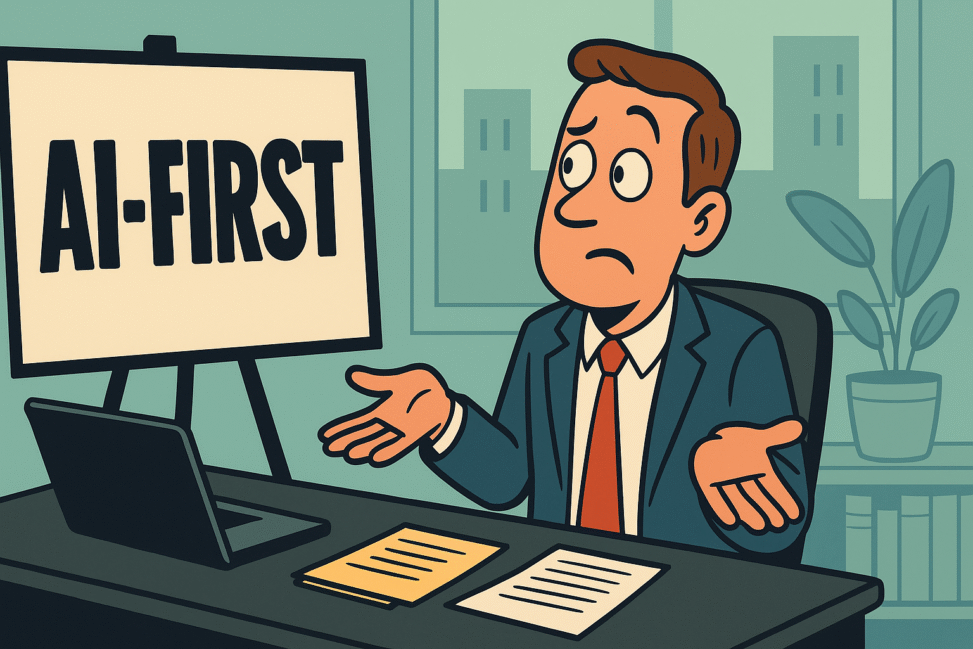
So, I keep seeing “AI-first” titles. Lovely. Sounds great! Looks even better… Now show me your SLOs, rollback plan and cost guardrails. If Finance can’t predict model spend to ±10% and Ops can’t roll an agent back in five minutes, it isn’t AI-first. It’s announcement-first.
Don’t take me wrong and I probably might be…. but I don’t think AI-first is like old cloud-first or mobile-first. Cloud-first was a venue change. You moved compute, wrapped it in IaC, tightened IAM, tuned for cost and availability. Deterministic systems, mature patterns, predictable bills. Then came Mobile-first, and that was a channel shift. You re-composed UX, added telemetry, push, offline sync. Again, mostly deterministic, easy to A/B, easy to roll back.
AI-first is a behaviour shift. You’re delegating decisions to probabilistic systems whose performance depends on data quality, prompts, retrieval pipelines, model updates you don’t control, and users who will try to break it. Testing becomes evaluation. Specs become guardrails. Versioning becomes lineage. Incidents include harms, not just downtime. Costs scale with tokens and drift, not only with requests and storage.
For those that want it, should think what “good” needs to look like: explicit SLOs for quality, latency and safety; shadow deployments before exposure; kill-switches and safe fallbacks; eval suites that run every change to data, prompts and models; red-team results you can defend to the Board; spend forecasts that survive QBR; post-mortems that change code and policy.
So, if your “AI-first” can’t name top failure modes, mitigations and the unit economics of a successful and a failed run, you’ve got a slogan, not an operating model. And for the C-board: “AI-first” right now, on a slide, is a stupid label. It means nothing.